A ball rolls under the sofa, a car zooms across the floor, a teddy bear waits for a hug. Every toy box is full of English waiting to happen, because toys come with names, sounds and actions that children love to repeat. Toy names in English for kids are some of the easiest first words: your child already knows each toy, already plays with it every day and already wants to talk about it. All you add is the English.
In this guide you’ll find the first toy names with a simple pronunciation hint, the play phrases that go with them, toy sounds, pretend play ideas, words for sharing and taking turns, a tidy-up routine in English and answers to the questions parents ask most.
In this guide
- Toy names in English for kids: the first ten
- Play phrases that go with every toy
- Toy sounds and action words
- Describing toys: big, little, soft and loud
- Pretend play in English
- Guessing games with toys
- Sharing and taking turns
- Tidy-up time in English
- Toys around the house and outside
- How lessons and toys work together
- Questions parents ask
Toy names in English for kids: the first ten
Start with the toys your child actually plays with. Ten names are plenty for the first weeks, and each one comes with a phrase you can say while you play.
 ball
 car
 teddy bear
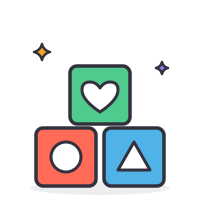 blocks
| Toy | Say it like | Play phrase |
|---|---|---|
| ball | BAWL | “Throw the ball!” |
| car | KAR | “Vroom! The car goes fast.” |
| doll | DOLL | “The doll is sleeping.” |
| teddy bear | TED-ee bair | “Hug the teddy bear.” |
| blocks | BLOCKS | “Stack the blocks.” |
| train | TRAYN | “Choo-choo! All aboard!” |
| puzzle | PUZ-ul | “One more piece!” |
| crayons | KRAY-onz | “Pick a crayon.” |
| bubbles | BUB-ulz | “Pop the bubbles!” |
| drum | DRUM | “Bang the drum!” |
Say the toy’s name on its own first, then inside the phrase. The single word is easy to catch, and the phrase shows your child what people actually do with the toy. You’ll notice that most toy names are short and strong, with one clear beat, which makes them perfect first words.
If your child already knows a handful of everyday words, toy names sit right next to them. For a wider base, the list of first 100 words for kids pairs well with the toy box.
Play phrases that go with every toy
Toy names become much more useful with a few action words around them. The same handful of verbs works with almost every toy in the house:
- Throw, catch, roll. “Roll the ball to me. Now catch!”
- Push and pull. “Push the car. Pull the train.”
- Stack and knock down. “Stack, stack, stack… and knock it down!”
- Open and close. “Open the box. What’s inside?”
- Hug and feed. “Hug the teddy. Is teddy hungry?”
Then add the little phrases that run through every game: “Let’s play!”, “Again!”, “Uh-oh, it fell!”, “Look at this!”, “All done.” These are the words your child hears most during play, so say them with lots of expression.
Toy sounds and action words
Toy sounds are a wonderful starting point. Sounds are fun to make, easy to copy and full of rhythm:
- A car says “vroom” and its horn says “beep beep”.
- A train says “choo-choo”.
- A drum says “boom” and a bell says “ding-ding”.
- Bubbles go “pop!” and blocks go “crash!” when the tower falls.
Different languages give toys different sounds, which children find very funny. Compare them together: how does a train sound in your home language, and how does it sound in English? Then link the sound to the name: “Vroom, vroom! It’s a car.”
Tatako’s favorite toy is the drum, with a bell and a shaker on the side. Make a toy band: your child on the drum, you on a pot with a spoon. Call out “Stop!” and everyone freezes, then “Play!” and the concert starts again.
Describing toys: big, little, soft and loud
Once your child knows a few toy names, add one describing word at a time. The easiest ones are words you can show with your hands and voice:
- “The big ball. The little ball.”
- “The teddy is soft. The block is hard.”
- “The car is fast. The train is slow.”
- “The drum is loud! Shh, the bell is quiet.”
Colors work the same way: the red car, the blue block, the yellow duck. In English the describing word comes before the toy, while many home languages put it after. There’s no need to explain the rule. Say it the English way every time, and the order soon sounds natural to your child.
Opposites are especially easy with toys, because you can hold both at once. A big block in one hand and a little block in the other says more than any explanation.
Pretend play in English
Pretend play gives toys a voice, and that voice can speak English. Three classic games need nothing but what you already have:
- Teddy’s tea party. Set out cups and plates for the stuffed animals. “Would you like some tea, Teddy?” “More cake, please!” “Thank you!”
- The toy shop. Line up toys on a shelf and take turns being the shopkeeper. “Hello! Can I have a ball, please?” “Here you go!”
- The doll’s bedtime. Put the doll to bed with the same words you use at night: “Pajamas on. Teeth brushed. Night-night, dolly!”
A sock puppet is the perfect partner for these games, because a puppet can speak only English while you speak your own language. Tatako would love one, but there’s a small problem: Tatako never wears socks, so every sock puppet in the house has to be borrowed from someone else.
Guessing games with toys
Guessing games get your child saying the toy names, not only hearing them.
- The mystery bag. Put one toy in a cloth bag. Your child feels it without looking and guesses: “Is it a car?” Then open the bag together: “It’s a car!”
- Toy by color. Ask for a toy by its color only: “Find something blue!” Then name it together: “A blue block!”
- Toy shadows. Hang a sheet and hold a toy behind it with a flashlight shining from the back. Your child, on the other side, names the shadow: “It’s the train!”
Swap roles too: your child picks the toy, and you ask, “Is it soft? Is it round?” before you guess.
Sharing and taking turns
Toys are also where children practice sharing, and that comes with some of the most useful phrases in English. Keep them short and say them the same way every time:
- “My turn. Your turn.”
- “Can I have a turn, please?”
- “Let’s share.”
- “You can play with it after me.”
Rolling a ball back and forth is the easiest way to practice. Each roll comes with “My turn!” and each catch with “Your turn!”, and your child learns the rhythm of a conversation without noticing it. When a turn is hard to give up, a sand timer helps: “When the sand is gone, it’s your turn.”
Tidy-up time in English
Tidy-up time happens every day, which makes it one of the best English routines in the house. Use the same signal each time, like a short song:
“Toys away, toys away,
we had fun, we had fun today!
Cars in the box, books on the shelf,
teddy on the bed, I did it myself!”
Sort the toys as you go, and name each group: “Blocks go in the bag. Crayons go in the cup. Balls go in the basket.” Sorting turns tidying into a game, and every toy put away is one more word heard. Counting helps too: “One car, two cars, three cars in the box!” That little “s” at the end is how English shows there’s more than one, and the short lesson on plural nouns with one cat and two cats practices the same pattern.
Make it a race against a timer, or let your child choose the order: “What goes first, the cars or the blocks?” A tidy-up song fits neatly into the rest of your daily routine in English, between play and dinner or before the bath.
Toys around the house and outside
Toys don’t live only in the toy box. Each place in the house has its own:
- In the bath: a rubber duck, a boat, a cup for pouring. “The duck is swimming!”
- In the bedroom: a teddy bear, books, a night light. “Teddy sleeps next to you.”
- Outside: a ball, a bike, a scooter, a kite, a bucket and shovel. “Look, the kite is flying!”
Bath time adds a quick game: float or sink? Drop the toys in one by one and guess together. “Will the boat float? Yes! Will the spoon sink? Splash!” Three new words from one bath.
Moving from room to room with toys is a nice way to add the names of the rooms and furniture too. You’ll find those in the guide to house words for kids.
How lessons and toys work together
Toys are where English gets used, and a short daily lesson keeps new words coming into the game. In every Tatako lesson, your child hears each word three times with a pause to repeat it, touches the right one of two pictures, and then sees the picture come back and names it first. It takes about five minutes a day, and there is nothing to read. A word from the morning lesson can go straight into the afternoon’s play: if today’s word was “train”, the train comes out of the box.
Your child learns English, while the guidance, menus and every step for you stay in your family’s language. After each lesson, you spend about two minutes marking how each word is going: new, repeat more, understands or can say. The shaky words come back first in the next lesson. Tatako works on the web, on Apple devices and on Android, and you can see how it all fits together on the Tatako home page. For a bigger plan around short sessions like these, read how to teach English to kids at home.
Try it today
- Wrap a toy in a towel like a present: “What’s in here?”
- Line up all the toy animals for a parade: “Here comes the duck!”
- Give a toy car a wash in the sink: “Scrub, scrub! Now it’s clean.”
- Stand three toys in a row from small to big: “Big, bigger, biggest!”
To go with this guide, print the action words flashcards and the star reward chart.
Questions parents ask
Which toy names should we learn first?
A favorite ball, car or teddy bear gets named again and again, and a name heard in a beloved game sticks much faster than one from a picture of a toy your child has never touched.
Do we need special toys for English?
A ball, some blocks and a teddy bear give you dozens of words and phrases. What matters is the talk around the toy, not the toy itself.
Can we play in both languages?
Keep each game in one language, so your child hears full phrases rather than a mix: a tea party in English this afternoon, building blocks in your home language after dinner.
How long should we play in English each day?
Two or three small moments spread over the day add up quickly, and a short game that ends while your child is still having fun does more than a long session that ends in tears.
What about toys that talk in English?
Talking toys can add some fun sounds, but they repeat the same few phrases whatever your child does. Your voice follows the game, answers your child and changes with every move, and that is what turns play into language.
What if my child answers in our home language?
Keep the game going and answer in English: when your child shouts the toy’s name in your home language, say “Yes, the ball!” and roll it back. Your English answer gives the word back in the middle of the fun, which is exactly where it sticks.
One ball, one car and one teddy bear: the toy box is the friendliest English corner in the house. When you want a new word to bring into the game, open today’s Tatako lesson.