
House words for kids are the easiest English a family can teach, because the lesson is already set up around you. Every day your child opens the same door, sits on the same chair, drinks from the same cup and climbs into the same bed. Each of those moments is a chance to hear one English word in the place where it lives. There is nothing to buy and nothing to prepare: the house does the work, and you add the words.
This guide walks through your home room by room: the kitchen, the bathroom, the bedroom and the living room. For each room you get the first words to start with, short phrases to say while you go about your day, and small games that take a minute or two. Then comes the house tour game, where your child shows you around in English, plus the mistakes that slow things down and what to do instead.
In this guide
- Why house words for kids come first
- Kitchen words: cup, spoon, table and chair
- Bathroom words: bath, soap, towel and toothbrush
- Bedroom words: bed, pillow, blanket and lamp
- Living room words: sofa, door, window and toys
- Little words that tie the rooms together
- The house tour game
- Four more games with house words
- Common mistakes with house words
- How Tatako lessons fit around your home
- Questions parents ask
Why house words for kids come first
Children learn the words they can touch. A cup is easier than “yesterday” because your child can hold it, drop it and ask for it again. House words are concrete, visible and repeated every single day, which is exactly what a new language needs at the start.
There is a second reason. Your child already knows these things in your family’s language. They know what a spoon is for and where the towels live. When you say “spoon” in English, you are not teaching a new idea, only a new name for an old friend. That makes house words a gentle first step: the meaning is familiar, so all the attention goes to the sound.
And house words travel. Once your child knows “door”, they hear it at grandma’s house, in picture books and in songs. The home is the training ground, and the words follow your child everywhere after that.
Kitchen words: cup, spoon, table and chair
The kitchen is the busiest room for language. Meals happen several times a day, the same objects come out every time, and your child is sitting still for once. Start with four or five words and add more only when the first ones feel easy.
 cup
 spoon
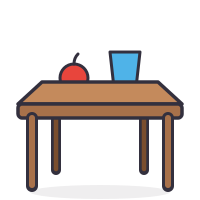 table
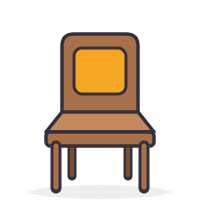 chair
| Word | Point to | Say it like this |
|---|---|---|
| cup | your child’s cup | “More water in your cup?” |
| spoon | the spoon in the bowl | “Here’s your spoon.” |
| table | the kitchen table | “Food goes on the table.” |
| chair | the chair at the table | “Sit on your chair, please.” |
| plate | a plate with food | “Your plate is empty!” |
| bowl | the cereal bowl | “One bowl for you.” |
| fridge | the fridge door | “The milk is in the fridge.” |
| sink | the kitchen sink | “Cups go in the sink.” |
Say the word on its own, then inside a short phrase, then once more when the object comes back to the table. “Cup. Here’s your cup. Cup!” It feels silly to adults and perfect to children. You don’t need to ask your child to repeat after you. Let the word come back meal after meal, and your child will join in when the game invites it.
Meals also give you natural questions with an easy answer. “Cup or spoon?” gives your child two choices, and a point at one counts as an answer. When the answer comes out loud as a short, wobbly word, answer with the full word and a big smile: “Spoon! Here you go.”
Bathroom words: bath, soap, towel and toothbrush
Bath time is slow, warm and full of things to name. Your child is happy, your hands are busy, and the same steps repeat every evening: water on, soap, splash, towel. That fixed order makes bathroom words stick fast.
- “Time for your bath!” when the water runs.
- “Here’s the soap. Slippery!” as it slides between your hands.
- “Towel, please” when bath time ends, and wrap your child up tight.
- “Where’s your toothbrush?” before bed, then “Brush, brush, brush.”
Add one body word if your child enjoys it: “Wash your hands. Wash your feet.” Keep the rest of the talk in the language you normally use at bath time. A few English words inside a familiar routine are worth more than a long speech nobody follows. If you already run a daily routine in English, bathroom words slot right into it.
Bedroom words: bed, pillow, blanket and lamp
The bedroom is the calmest room in the house, which makes it the best place for quiet repetition. At night the same few things come out in the same order, and your child listens closely because the day is winding down.
- “Into bed!” as your child climbs in.
- “Pillow for your head.” Pat it twice.
- “Blanket on. Snug!” Tuck the edges in.
- “Lamp off. Good night.” Then a whisper: “Night night, bed.”
Mornings work too. “Open the curtains. Hello, window!” is a cheerful start to the day, and it brings a new word along with the light. Saying good morning to a room is silly, and silly is memorable.
Living room words: sofa, door, window and toys
The living room is where play happens, so its words come wrapped in action. Toys fly, the sofa becomes a mountain, and the door is always opening for someone.
- “Sit on the sofa with me.”
- “Knock, knock! Who’s at the door?”
- “Look out the window. A bird!”
- “Toys in the box!” at clean-up time.
Clean-up is a gift for language. Every toy that goes into the box is a chance to name it: “Ball in the box. Book in the box. Car in the box.” The phrase stays the same and only one word changes, so your child can join in on the part they know. Before long you will hear a proud “in the box!” from across the room.
Little words that tie the rooms together
Nouns are the start, but a few small words turn a list into real English. “In”, “on” and “under” work in every room: the spoon is in the cup, the book is on the table, the cat is under the chair. Use them while you tidy up or hunt for lost things, and point as you say them.
Add a handful of action words next: open, close, sit, wash, sleep, turn on, turn off. “Open the door. Close the door.” “Sit on the chair.” “Turn off the light.” Children love giving these commands back to you, and following a small order from a small person is one of the best games in the house. For the bigger picture beyond house words, the ten habits for teaching English to kids at home show how to keep English going all week.
The house tour game
The house tour is the game that puts all the rooms together. Your child becomes the guide, and you are the visitor who has never seen the house before. It takes a few minutes and needs nothing but the house itself.
- Ring the bell. Stand outside the front door, press the bell and say: “Ding-dong! Hello! Can I see your house?”
- Let your child lead. Follow from room to room. At each doorway, ask: “What’s this room?” If the answer comes in your family’s language, echo it in English with a smile: “The kitchen! Yes!”
- Ask for one thing per room. “Show me the bed.” “Where’s the soap?” Your child runs, points and gets to be the boss.
- Swap roles. Next time, you are the guide and your child is the visitor. Make a few silly mistakes on purpose: point at the fridge and say “bed”. The laughter that follows is your child correcting you, in English.
- End with a goodbye. Back at the front door: “Thank you! Bye-bye, house!”
For a quieter version, take a teddy on the tour. Your child shows the teddy around, and you speak for the teddy in a funny voice. Shy children often talk more easily to a toy than to a grown-up, and the teddy never minds a wrong word.
Four more games with house words
- Treasure hunt. Hide a spoon somewhere in the living room and give clues: “Is it under the sofa? Is it on the table?” Your child hunts, and you cheer every guess. A question flips “it is” into “is it”, and our sight words lesson with is, it, in, can and go practices both.
- What’s missing? Put four house things on a tray: a cup, a spoon, a toothbrush and a book. Name them together, cover the tray, and take one away. Then lift the cover and ask: “What’s missing?”
- Sticky notes. Put a small sticky note on five things you want to name this week: door, fridge, bed, chair, window. The notes are a reminder for you, not reading practice for your child. Every time you pass one, say the word. When a word feels easy, move its note to something new.
- Homemade picture cards. Draw a cup, a bed, a door and a chair on scraps of paper and spread them on the floor. Your child picks a card, says the word with you and runs to touch the real thing. Drawing your own house together makes a calm finish: name each room as you add it.
All of these games work by ear, long before letters mean anything to your child. That is the idea behind English before reading: sounds, pictures and real things come first, and the written word can wait.
Common mistakes with house words
Too many labels at once. Twenty sticky notes on the first day turn the house into noise. Choose words from the rooms where you spend the most time, so each note gets said out loud many times a day.
Turning words into a quiz. “What’s this? What’s this? And this?” puts your child on the spot. Name things far more often than you ask about them. Questions work best inside games, with a clear answer and plenty of cheering.
Translating every word. If you say “cup” and then the same word in your family’s language every single time, your child learns to wait for the translation. Say the English word with the object in your hand. The cup explains itself.
Only nouns, no life. Naming objects is a start, but a house full of labels and no talk feels like a museum. Put each word inside a tiny action: “Cup, please.” “Shut the door.” “Bedtime!”
How Tatako lessons fit around your home
House words grow best with a short, steady moment of English every day. A Tatako lesson gives your child exactly that: about five minutes, with nothing to read. Your child hears each word three times, with a pause after each one, then touches one of two pictures. A moment later the picture comes back, and your child gets to say the word first.
After the lesson, you spend about two minutes marking each word: new, repeat more, understands or can say. Shaky words come back first. Your child learns English, while prompts, menus and every step of guidance are in your family’s own language. And when a lesson word like “door” or “bed” turns up at home, you know exactly what to point at. Short beats long here, and five minutes a day explains why.
Try it today
- Pick one room, the kitchen, and three words: cup, spoon, table.
- At breakfast, put the cup upside down and ask: “Is this right?” Let your child turn it over, and say “cup” together.
- At lunch, ask for the spoon and let your child hand it to you.
- Before bed, let your child pick a favorite of the three words and say it together one last time on the way out of the kitchen.
To go with this guide, print the things at home flashcards and the coloring pages of things at home.
Questions parents ask
Which room should we start with?
Start with the room where you and your child already talk the most. For most families that is the kitchen, thanks to meals, but a family that loves bath time can begin in the bathroom just as well. The best first room is the one where English fits without any extra effort.
How do we say house words if our own English is basic?
House words are short and simple, and your child gains a lot from hearing them from someone they love. Check any word you are unsure of, say it once or twice on your own, then use it with confidence. Mixing English with your family’s language is normal and healthy.
My child answers in our family language. Is that a problem?
Answering in the family language means your child understood the English word, and that is the first big win. Keep playing in English and welcome an answer in either language. Once a word feels familiar, hand the turn to your child with a half-finished phrase, “Here’s your…”, and wait with a smile for the last word.
How many house words should my child know?
A few words your child understands and enjoys are worth more than a long list. Keep a short note of the words your child understands and the ones they say, and add new ones as the note fills up.
What if my child gets bored of the same words?
Change the game, not the words. A familiar word in a new game feels brand new to a child. Say it in a squeaky voice, a whisper or a robot voice, or let your child be the one who asks the questions for a while.
Your home already holds the words your child needs to start: the cup, the door, the bed and the chair. Name them as you go, play the house tour when the mood is right, and let the words pile up day by day. When you want a ready-made moment of English to share, open a Tatako lesson and sit side by side. More ideas for family English are waiting on the Tatako home page.
Still have a question? Ask Nuri.