
· Grammar
Plural nouns lesson
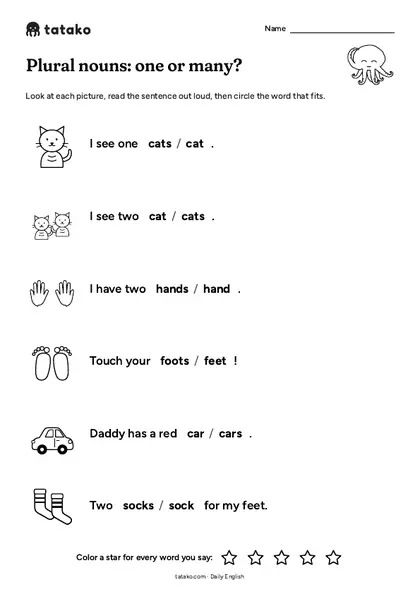
Plural nouns name more than one thing, and most add s: one cat, two cats. Your child counts aloud and meets the rule breakers.
Hear it, say it
Tap a picture to hear one and two, then the sentence. Hold up your fingers as you count.
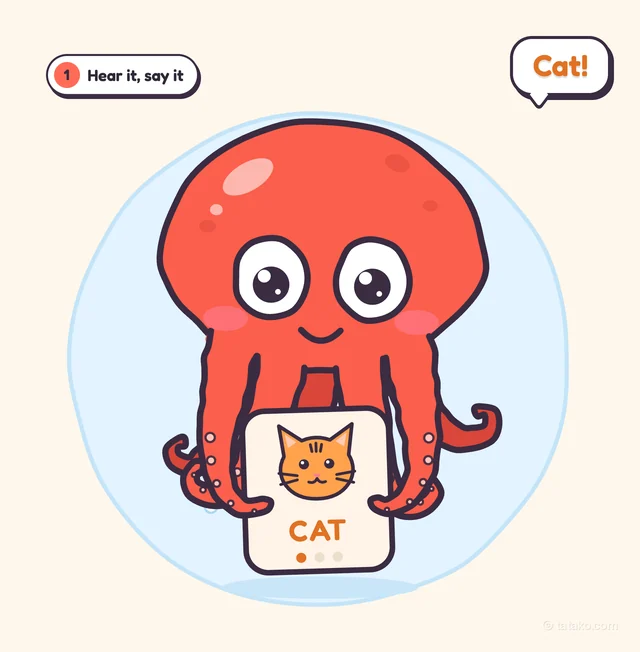
Your child’s turn: a lesson with Tatako
In the app, Tatako says each new word, your child finds its picture and says it back to you. A lesson takes about five minutes, and the first one is free, without a card.
Why does the s in cars sound like z?
Because car and hand end in a buzzing sound, and the s buzzes along: cars sounds like carz. After cat and sock it stays a sharp s.
A few words change inside instead: tooth and teeth, mouse and mice.
What kids often say, and what to say back
Not quitetwo cat
Saytwo cats
The number already says many, so kids drop the s. Hold up two fingers: cat-s.
Not quitetwo foots
Saytwo feet
Foots means the s rule has landed. Say it back the right way with a smile.
Not quitethree sheeps
Saythree sheep
Sheep stays the same for one and many, just like fish.
Try it at home
- Count socks as you sort the laundry: one sock, two socks. Your child says each one with the s.
- Play “one or many” with toy cars: put out one car or a handful, and your child says car or cars.
- At bath time, name the pairs: two hands, two eyes, two ears, two knees.
Keep going
Every count is a chance to hear the s, and our guide to counting for kids has five-minute games with fingers and toes. Hands, eyes and feet also star in teaching body parts in English, built around a simple point-and-name game.
Every topic so far is in Daily English.


Short a CVC words for kids
Short a CVC words have three sounds with short a in the middle: bag, map, fan, jam, pan. Today your child blends them into words.
Thanksgiving words for kids
Thanksgiving words for kids start at the table: turkey, pie, pumpkin, corn and the feast itself. Today your child names them all.
Verbs for kids
Verbs are doing words: run, jump, clap, hug and sing. Your child says dozens a day, and today they spot them and act them out.
Ready for the next lesson?
Your child learns English. The prompts, the menus and every step of guidance are in your family’s own language.
Start a lesson
