The names of fruits in English are short, everyday words that a child can see, touch and taste: apple, banana, orange, grape, strawberry, pear, mango and watermelon. Start in your own kitchen: when your child picks up one of the fruits, name it together, and add new ones as they turn up at the store or in a lunchbox.
Many fruits come and go with the seasons. In North America and Europe, strawberries and cherries arrive in early summer, peaches and watermelons in the hottest months, apples and pears in the fall, and oranges and clementines in winter.
In this guide
The first fruit names to learn
The first fruit names to learn are the ones your child eats most often, and in many homes that means apple, banana, orange and grape. The table gives a simple way to say each name and the word for more than one.
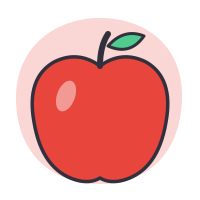 apple
 banana
 orange
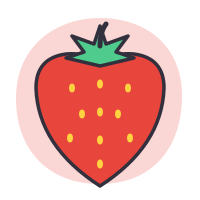 strawberry
| Fruit | Say it like | More than one |
|---|---|---|
| apple | AP-ul | apples |
| banana | buh-NAN-uh | bananas |
| orange | OR-inj | oranges |
| grape | grayp | grapes |
| strawberry | STRAW-bair-ee | strawberries |
| pear | pair | pears |
| peach | peech | peaches |
| cherry | CHAIR-ee | cherries |
| mango | MANG-go | mangoes |
| pineapple | PINE-ap-ul | pineapples |
| watermelon | WAW-ter-mel-un | watermelons |
| lemon | LEM-un | lemons |
Most fruit names simply add -s for more than one: one apple, two apples. A name that ends in a consonant and -y changes to -ies, so cherry becomes cherries, and peach takes -es because it ends in a ch sound. Mango has two accepted plurals, mangoes and mangos. Our lesson on plural nouns practices the same pattern with animals.
Pear and pair sound exactly the same, which makes a good joke for a child who already knows the word pair from socks and shoes: hold up two pears and call them a pair of pears.
Fruit names by color
Fruit names by color fall into easy groups, and each group teaches a color word too. Here is one way to group the fruits you are most likely to find:
- Red: apple, strawberry, cherry, raspberry
- Yellow: banana, lemon, pineapple
- Green: pear, lime, kiwi, green grapes
- Orange: orange, peach, apricot, papaya
- Purple, blue and black: plum, blueberry, blackberry
Some fruits change color as they ripen, which gives you something new to talk about every day. A banana goes from green to yellow to spotty brown, and a ripe mango can be green, yellow, orange or red, depending on the kind. Ask your child to pick the yellow banana or the green one. Apples come in red, green and yellow, and the name stays the same whatever the color.
If color words are new as well, our guide to teaching colors in English has games that work just as well with a fruit bowl.
Tropical fruit names
The most common tropical fruit names are mango, papaya, pineapple, coconut and guava. In much of the world these are the everyday fruits, and a child in Brazil, India or Indonesia may eat papaya and guava long before cherries or plums.
- mango and papaya, sweet and soft, with orange flesh
- pineapple, spiky outside and juicy inside
- coconut, with a hard brown shell, white flesh and coconut water
- guava (GWAH-vuh), pink or white inside, full of small seeds
- passion fruit, wrinkly outside, with seeds in a sweet, tangy pulp
- lychee (LEE-chee), a bumpy red skin around white fruit
- dragon fruit, pink with green flaps, white or red inside with tiny black seeds
- jackfruit, the biggest fruit that grows on a tree
Many local fruits have no other name in English: rambutan and durian came into English from Malay and kept their Malay names.
Where fruit names come from
Many English fruit names came from other languages, often on ships, together with the fruit itself. A word with a story is easier to remember, and these stories are short enough to tell at the kitchen table.
| Fruit | Where the name comes from |
|---|---|
| orange | From Sanskrit, through Persian, Arabic and French. The color was named after the fruit. |
| banana | Probably from a West African language, through Portuguese or Spanish. |
| mango | From Malayalam or Tamil, spoken in southern India, through Portuguese. |
| avocado | From Nahuatl, the language of the Aztecs, through Spanish. |
| coconut | From the Portuguese word coco, a grinning face, because of the three dark marks on the shell. |
| pineapple | Once the English word for a pine cone, which the fruit looks like. |
| kiwi | Named after the kiwi, a bird from New Zealand. |
| grapefruit | It grows in bunches on the tree, like grapes. |
The coconut story works best with a real coconut. Show your child the marks and ask which two are the eyes and which one is the mouth.
Fruit or vegetable?
A tomato is a fruit to a gardener and a vegetable in the kitchen, and the same is true of cucumbers, peppers, pumpkins and avocados. In plant terms, a fruit is the part that grows from a flower and holds the seeds. In everyday English, people call the sweet ones fruit and the savory ones vegetables, which is why tomatoes end up in salads and soups. Strawberries hold the opposite surprise: each tiny yellow dot on the outside is a fruit of its own, with a seed inside.
The question even reached the United States Supreme Court. In 1893 the court decided that tomatoes should be taxed as vegetables, because that is how people cook and eat them.
Kids enjoy the surprise. Cut a tomato and a cucumber open, find the seeds together and ask, “Fruit or vegetable?” Either answer can be right, as long as your child can say why.
Words for talking about fruit
Fruit names go further with a few words for the parts of a fruit, how it tastes and what you do with it. These are the words your child will hear while you shop, cut and share fruit:
- Parts: peel, skin, seed, core, stem, juice. Americans call the big hard seed in a peach, cherry or mango a pit, and British speakers call it a stone.
- Tastes and feels: sweet, sour, juicy, crunchy, soft, sticky, smooth, bumpy.
- Ripe or not: ripe, not ripe yet, too ripe. An old saying plays with this: blackberries are red when they’re green. A blackberry that is still green, meaning not ripe, is red.
- Actions: wash, peel, cut, slice, squeeze, bite, share.
Put the words together in short sentences while you work: “The lemon is sour.” “Can you peel the banana?” “This pear is not ripe yet.” For vegetables, snacks and words for the table, see our guide to food words in English.
How to say tricky fruit names
The trickiest fruit names are the long ones and the ones that are not spelled the way they sound. Say these slowly, one beat at a time:
- raspberry: the p is silent, RAZ-bair-ee
- pomegranate: POM-uh-gran-it
- avocado: av-uh-KAH-doh
- papaya: puh-PIE-uh
- apricot: AP-ri-kot or AY-pri-kot, both are common
- kiwi: KEE-wee
Banana has a British version too: buh-NAH-nuh, with the middle sounding like the a in father.
Clapping the beats helps with long names. Watermelon gets four claps, wa-ter-mel-on, and pineapple gets three, pine-ap-ple. Our lesson on clapping syllables in food words turns this into a game.
How to teach fruit names at home
The easiest way to teach fruit names is to say them while the fruit is in your child’s hands. A real fruit gives the word a color, a smell, a weight and a taste, and all of that helps it stay.
- Offer a choice at snack time. “Do you want an apple or a pear?” A choice question invites a fruit name as the answer, even if it starts as a point and one word.
- Shop together. Ask your child to find the bananas and put three oranges in the bag. At the checkout, let your child name each fruit as it goes on the belt.
- Talk while you cut. Name each step as you go: wash, peel, slice. Let your child do the easy parts.
- Make a fruit salad. Name every fruit as it goes into the bowl, then ask your child to name what is left on the board.
- Draw and label. Draw a fruit together and write its name underneath, then let your child color it in and put it on the fridge.
Fruit games for kids
The best fruit games for kids are fruit salad, mystery bag, fruit shop, what’s missing and fruit riddles, and each one takes only a few minutes.
1. Fruit salad
Everyone sits in a circle and gets a fruit name: apple, banana or grape. When you call “apple,” all the apples swap seats. When you call “fruit salad,” everyone swaps at once.
2. Mystery bag
Put one fruit in a cloth bag. Your child feels it without looking and guesses: “Is it a lemon?” Swap roles, and let your child choose the fruit next time.
3. Fruit shop
Your child runs the shop and you are the customer: “Can I have three bananas, please?” Your child counts them out and hands them over, and you say thank you.
4. What’s missing?
Put four fruits on the table and name them together. Your child closes their eyes while you hide one, then opens them and tells you which fruit is gone.
5. Fruit riddles
Give three clues and let your child guess: “I’m green outside. I’m red inside. I have lots of black seeds. What am I?” There are more in our collection of riddles for kids.
Fruit names in two languages
Fruit names are an easy place to start with two languages, because many of them sound alike. Banana is banana in Portuguese and Italian, Banane in German, and plátano or banana in Spanish, depending on the country. Mango is mango in Spanish and Italian and manga in Portuguese.
Pineapple is the odd one out. French, German, Italian and Dutch all say ananas, Spanish says piña, and in Brazil it is abacaxi.
If one parent speaks English and the other uses a different language at home, each can name the fruit in their own language. A child who hears manzana from one parent and apple from the other soon understands that one fruit can have two names. Our guide to one parent, one language explains how families set this up.
Try it today
- Find a fruit with a pit.
- Clap the beats in pineapple.
- Say “ripe” or “not ripe yet” about one fruit.
Questions parents ask
Is it fruit or fruits?
Fruit is the usual word for fruit in general: “I eat fruit every day” and “a bowl of fruit.” Fruits is used for different kinds of fruit, as in “tropical fruits” or “the fruits of summer.”
Why is it an apple but a banana?
An goes before a word that starts with a vowel sound: an apple, an orange, an apricot. A goes before a consonant sound: a banana, a pear, a mango.
How many fruit names should we learn at once?
Three or four new names at a time is plenty. When your child can name them without help, add the next few.
How can we practice fruit names when a fruit is out of season?
Pictures, toy fruit, frozen fruit and dried fruit all count. Dried fruit even brings new words: raisins are dried grapes, and prunes are dried plums.
My child only eats bananas. How do we learn other fruit names?
Words can come before tasting. Name fruits in pictures, at the store and in games, and let your child touch and smell a new fruit without having to eat it.
For more first words in English, try a Tatako lesson with your child: each word is said three times, with a pause for your child to say it back, in about five minutes a day.