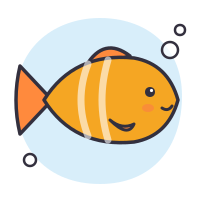
A fish name in English is often the one Indian families already use: rohu, catla and hilsa keep their names, while bangda becomes Indian mackerel, surmai becomes seer fish and bombil becomes Bombay duck, which is a fish and has nothing to do with ducks. The Zoological Survey of India counts almost four thousand kinds of fish in the rivers, lakes and seas of India, and the ones your family buys and cooks are the best first fish names to learn, because your child already knows them by sight and by taste.
Fish is one of the first animal names many children say, and each kind of fish on a plate or in a pond is one more word to learn.
In this guide
Fish name list
The fish on this list are the ones Indian families buy most often, each with its English name, its Hindi or local name and the water it comes from:
| English | Hindi or local name | River or sea |
|---|---|---|
| rohu | rohu (रोहू), rui in Bengali | river and pond |
| catla | katla (कतला) | river and pond |
| mrigal | mrigal (मृगल) | river and pond |
| walking catfish | mangur or magur (मांगुर) | pond and swamp |
| hilsa | hilsa (हिलसा), ilish in Bengali | sea and river |
| silver pomfret | paplet (पापलेट) | sea |
| Indian mackerel | bangda (बांगड़ा) | sea |
| seer fish or kingfish | surmai (सुरमई) | sea |
| Bombay duck | bombil (बोंबील) | sea |
| Indian salmon | rawas (रावस) | sea |
| sardine | tarli (तारली), mathi in Malayalam | sea |
When a fish has two English names, as seer fish and kingfish do, shops use either one.
River fish and sea fish
River fish live in fresh water, in rivers, lakes and ponds, and sea fish live in the salty water of the sea. English calls the first group freshwater fish and the second saltwater fish or sea fish:
- Freshwater fish: rohu, catla, mrigal, magur, tilapia, carp and mahseer, a big fish of fast hill rivers.
- Sea fish: pomfret, mackerel, seer fish, sardine, tuna, Bombay duck and Indian salmon.
- Fish of both: hilsa, which swims from the sea up rivers such as the Ganga, the Padma and the Godavari to lay its eggs during the monsoon.
Rohu, catla and mrigal are often raised together in one pond, because catla feeds near the top of the water, rohu in the middle and mrigal near the bottom, so the three share a pond without taking each other’s food. Fish farmers call them the Indian major carps.
In Andhra Pradesh, a hilsa caught in the Godavari during the monsoon floods gets a name of its own, pulasa, and it is one of the most prized fish of the year. Rivers, ponds and the sea are animal homes too, as our guide to animals and their homes shows.
Parts of a fish
The parts of a fish are the head, the gills, the fins, the scales and the tail, and each one has a job in the water:
- Gills: on each side of the head, under a flap called the gill cover. Water goes in through the mouth and out over the gills, which take oxygen from it, the way our lungs take oxygen from the air.
- Fins: the tail fin pushes the fish forward, and the fins on its back, its belly and its sides keep it steady, steer it and stop it.
- Scales: thin, hard plates that overlap like tiles on a roof and protect the skin. A coat of slime over them helps the fish slip through the water.
- Eyes: most fish have no eyelids, so they cannot blink or close their eyes.
- Lateral line: a thin line along each side of the body that feels the movement of the water, so a fish knows when something swims close, even in the dark.
Inside, many fish have a swim bladder, a small bag of gas that lets them float at one depth without swimming. Sharks have none, and a big oily liver helps keep them up.
Animals called fish that are not fish
Many animals with fish in their names are not fish at all, because they were named for living in the water long before anyone looked closely at their bodies:
- Shellfish: prawns, crabs, lobsters and mussels have shells and no backbones, even though they are sold at the same counter as fish. In American English, prawns are usually called shrimp.
- Cuttlefish: a cousin of the octopus and the squid, with a soft body, eight arms and two long tentacles.
- Crayfish: a small animal of rivers and ponds that looks like a tiny lobster.
- Silverfish: a small, shiny insect with no wings that hides in damp corners of a house.
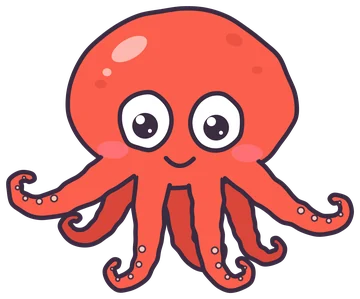
Tatako is a small round octopus, and octopuses are not fish either: they have no bones at all. It works the other way around too, because a seahorse, an eel and a stingray look nothing like a rohu, and all three are fish.
Our animal coloring pages have a whale to color next to cats, dogs and lions, one big picture per page with the English word to trace, and a whale is not a fish either: it breathes air, just like a cat or a dog.
Pet fish names
Pet fish names children hear most often are goldfish, guppy, molly, betta and angelfish, the small fish kept at home in a fish tank or a bowl:
- Goldfish: first kept in China more than a thousand years ago, and today orange, red, white or black, even though the name says gold.
- Guppy: a tiny, bright fish named after Robert Guppy, who sent some from the island of Trinidad to London in 1866.
- Molly: a calm little fish, black, white or speckled.
- Betta: also called the Siamese fighting fish, with long, flowing fins. Two males fight, so each male lives in a tank of his own.
- Angelfish: a tall, flat fish with long fins that look like wings.
- Koi: big, colorful carp from Japan, kept in garden ponds.
Pet fish bring their own words with them: fish tank, fishbowl, filter, fish food and the daily job, “Time to feed the fish.” Near a garden pond or a big tank, keep a hand on your child, since a small child can slip into even shallow water.
Fish words in the kitchen
Fish words in the kitchen start with the dishes: fish curry, fish fry and fish tikka, machher jhol in Bengal, meen curry in Kerala and fish and chips in Britain. Before frying, fish is often rubbed with turmeric and chili powder, two words from our guide to spices.
- Fillet: a long piece of fish cut from the side, with the bones taken out.
- Steak: a thick slice cut across the fish, with the backbone in the middle, the way rohu and surmai are usually cut.
- Bones, skin and scales: the parts taken off before or after cooking.
- Fish fingers: strips of fish in breadcrumbs, called fish sticks in American English.
One kitchen word has two meanings. In Indian English, a fish fry is a plate of fried fish, and to fish farmers, fry are very young fish, so a pond full of fry has nothing to do with lunch.
Fish bones are thin and sharp, so pick every one out before fish goes on a child’s plate, even from a fillet, and break the fish into small flakes with your fingers to feel for any that are left.
Where fish names come from
Fish names in English come from many places, and the word fish itself goes back to Old English fisc, a cousin of the Latin word piscis, which gave its name to Pisces, the sign of the two fish.
Many English names describe the fish. A catfish has long whiskers around its mouth, like a cat’s, a swordfish has a long, flat snout shaped like a sword, a parrotfish has teeth joined into a hard beak, like a parrot’s, and a goldfish was named for its color.
Other names came from far away. Pomfret most likely comes from the Portuguese word pampo, which reached English through French, and sardine goes back through French and Latin to a Greek name that may come from the island of Sardinia. Salmon has a silent l: the word came into English from French as samoun, and the l was added to the spelling later to match the Latin salmo, but people never started to say it, so salmon sounds like SAM-un.
Bombay duck is the strangest name on the list. The English name was already in print in the early 1800s, decades before the first train in India ran in 1853, so the popular story about a smelly mail train, the Bombay daak, came later. Dictionaries trace the name to the fish’s own name, bombil.
Fish idioms in English
Fish idioms in English use fish to describe people and what they do:
- Like a fish out of water: uncomfortable in a new place. “On her first day at dance class, she felt like a fish out of water.”
- A big fish in a small pond: someone important in a small group.
- Something fishy: something that seems wrong. “Something’s fishy here. Where did all the cookies go?”
- Bigger fish to fry: more important things to do.
- Fish for compliments: say something to get others to praise you.
- Plenty more fish in the sea: many other chances, often said to cheer someone up.
Children take idioms literally at first: a child who hears “something fishy” may go and look for the fish. Explain the picture behind each one, such as a fish flapping on dry land for a fish out of water, and the meaning makes sense.
Fish names in other languages
Fish names in other languages start with the word for fish: machhli (मछली) in Hindi, maach in Bengali, masa in Marathi, meen in Tamil and Malayalam, meenu in Kannada and chepa in Telugu.
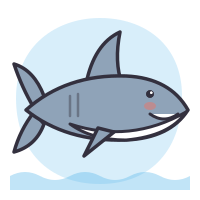 shark
 crab
| English | Hindi | Spanish | French |
|---|---|---|---|
| fish in the water | machhli (मछली) | pez | poisson |
| fish on the plate | machhli (मछली) | pescado | poisson |
| goldfish | sunahri machhli (सुनहरी मछली) | pez de colores | poisson rouge |
| shark | shark (शार्क) | tiburón | requin |
| prawn | jhinga (झींगा) | gamba or camarón | crevette |
| crab | kekda (केकड़ा) | cangrejo | crabe |
| to fish | machhli pakadna (मछली पकड़ना) | pescar | pêcher |
Spanish has two words where English has one: pez for a fish that is alive and swimming, and pescado for fish as food, so a cook buys pescado and a child watches a pez in a pond. French calls a goldfish poisson rouge, a red fish. Our post on the mother tongue has more on keeping the language of home alive next to English.
Games with fish names
Games with fish names need paper, scissors, tape, a marker, a short ribbon, strips of colored paper and an old newspaper, and one game needs only a whole fish bought for dinner: paper koi, woven scales, fish from shapes, fan the fish and real fish, real parts.
1. Paper koi
In Japan, families fly koi streamers called koinobori for Children’s Day, and a paper one takes five minutes. Roll a sheet of paper into a tube and tape it, draw a big eye and a mouth at one end, and tape strips of paper to the other end as the tail. Your child adds scales and fins with a marker, naming each part: “Eye, mouth, fins, tail!” Tape both ends of the ribbon inside the mouth as a handle, then walk outside on a windy day and watch the koi fill with air: “The koi is swimming!” Keep the ribbon short, and put the koi away when the game ends.
2. Woven scales
Cut a big fish shape out of paper, fold it in half along the body and make four or five cuts from the fold toward the edge, stopping short of it. Unfold it, and your child weaves strips of colored paper in and out of the cuts until the body is covered in small squares that look like scales. Add a fin, a tail and an eye with a marker, and name each one as it goes on: “Scales! Now the fin, the tail and the eye.” The grown-up does all the cutting and keeps the scissors out of reach.
3. Fish from shapes
Draw a fish together from shapes your child knows: an oval for the body, a triangle for the tail, a small circle for the eye and two little triangles for the fins. Say each shape as it goes on, then the part of the fish it makes: “An oval. That’s the body. A triangle. That’s the tail.” Then your child draws the next fish and gives it a name from the list. Our guide to shapes has all the shape words.
4. Fan the fish
Cut a few fish out of thin paper, give each one the name of a fish from the list and lay them in a row at one end of the room. Fold the newspaper in half, and your child fans it hard behind one fish to push it across the floor with air alone: “Go, pomfret, go!” Name each fish as it reaches the far wall: “The surmai made it!” Play on a smooth floor with nothing to trip over.
5. Real fish, real parts
When a whole fish comes home for dinner, put it on a plate before it is cleaned and let your child find the parts: lift the gill cover with a finger to see the red gills, spread a fin like a fan, run a finger from tail to head to feel the scales catch, and look for the thin line along its side. Then name the fish together: “It’s a pomfret. Pomfret!” The grown-up handles the knife and the cleaning, and everyone washes their hands with soap after touching raw fish.
Try it today
- Let your child choose the fish for your next fish dinner, and say its English name together.
- When fish comes to the table, name the dish in English before the first bite: “Fish curry tonight.”
- Next time you pass a pond or a fish tank, ask your child to find a fin and a tail.
Questions parents ask
Is a shark a fish?
A shark is a fish: it lives in water, breathes through gills and swims with fins. Its skeleton is made of cartilage, the bendy material in a person’s nose and ears, where most other fish have bones, and its skin is covered in tiny toothlike scales that feel like sandpaper.
Is it fish or fishes?
Fish is the usual plural: one fish, two fish, a pond full of fish. Most animal names add s for more than one, like the cats in our lesson on plural nouns, and fish is one of the few that stay the same, like sheep and deer. Fishes is used when people talk about different kinds of fish, as in “the fishes of the Indian Ocean,” and a group of fish swimming together is a shoal, one of the collective nouns for animals.
Can fish breathe out of water?
Most fish cannot, because their gills work only in water: in air, the thin gill sheets stick together and stop taking in oxygen. A few fish can breathe air as well, and the magur is one of them: it can wriggle across wet ground from one pond to the next, which is why its English name is walking catfish.
What is the biggest fish in the world?
The biggest fish in the world is the whale shark, which can grow longer than a bus and eats tiny sea creatures called plankton. Whale sharks visit the coast of Gujarat, and in 2001 India made the whale shark the first fish to get the highest protection under its wildlife law, the same as the tiger.
Every trip to the fish market can bring home a new English word, and a Tatako lesson brings more: it takes about five minutes a day, and each new word comes three times, with a pause for your child to answer.