Where is the ball? Under the bed. Where are your shoes? Next to the door. A day at home is full of little questions about where things are, and the answers use some of the smallest and most useful words in English. Prepositions for kids are words like in, on, under and behind: they tell us where something is or where it is going. They are short, they come up all the time, and children learn them best with their hands, their toys and their whole body.
This guide covers which prepositions to start with, how to bring them into play and daily routines, the games that make them stick, and the mix-up that many families meet along the way.
In this guide
- Why prepositions for kids are worth learning
- The first three: in, on and under
- Next up: next to, behind and in front of
- Words for moving: up, down, into and out of
- A box, a toy and a “where is it?” game
- Prepositions all around the house
- Games that make position words stick
- The in and on mix-up, and how to handle it
- How the app supports position words
- Questions parents ask
Why prepositions for kids are worth learning
A child who knows ball, cup and teddy can name things. A child who also knows in, on and under can tell you where those things are, follow a simple request and join a real game. Now your child can say “ball under bed” or “The ball is under the bed” and get the ball back.
Prepositions also make English feel useful right away. “Put your cup on the table.” “Your coat is behind the door.” “Jump into the box!” These are real moments, not drills, and your child understands them because the action shows what the word means. You never need to explain grammar. You show, you say, and your child does.
There is one more reason to start: these little words are everywhere. They turn up in almost every sentence your child hears, in stories, songs and play. Once in and on make sense, a whole layer of English opens up.
The first three: in, on and under
Start with three words that are easy to show and easy to see: in, on and under. You need one box, one toy and a few minutes. Put the teddy in the box and say, “In! Teddy is in the box.” Put it on the box: “On! Teddy is on the box.” Then slide it under: “Under! Where is teddy? Under the box.” “In” also appears in our sight words lesson with is, it, in, can and go, inside short sentences like these.
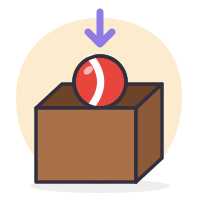 in
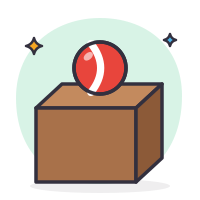 on
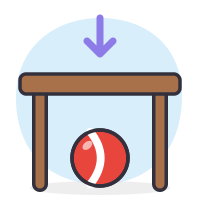 under
| Word | Show it with | Say it |
|---|---|---|
| in | a toy inside a box or a cup | The car is in the box. |
| on | a toy on top of a chair | The cat is on the chair. |
| under | a toy below the table | The ball is under the table. |
| next to | two toys side by side | The bear is next to the car. |
| behind | a toy hidden at the back of a pillow | The duck is behind the pillow. |
| in front of | a toy right at your child’s feet | The ball is in front of you. |
Say the preposition on its own first, with a little extra stress, and then inside a short sentence. The single word is easy to catch, and the sentence shows how it lives in real English. Repeat the same three positions many times before adding new ones. Children love predictable play, and the repetition is exactly what turns a new word into a familiar one.
Next up: next to, behind and in front of
Once your child moves the toy to the right spot when you say in, on or under, add the next group: next to, behind and in front of. These need two objects, so line up two toys: “The car is next to the bear.” Then hide one: “Where is the duck? Behind the pillow!”
Behind and in front of are easiest with your child’s own body. Stand in front of your child, then step behind. Say each one as you move: “I’m in front of you. Now I’m behind you!” Then swap roles and let your child walk around you. Body play is often the moment the words click, because your child feels the position as well as seeing it.
Between is the cuddliest of them all. Sit your child between two pillows, or between two people they love, and say, “You are between Mommy and Daddy.” A hug from both sides makes it the favorite word of the day.
Tatako has an unfair advantage in these games: with eight arms, Tatako can be in the box, on the box, under the box and next to the box all at once, with four arms left over for waving.
Words for moving: up, down, into and out of
Some prepositions describe movement rather than a place. Up and down are the easiest: on the stairs, on the slide, when a ball goes up and comes back down. Into and out of fit bath time, getting in and out of the car, and every toy that goes into a basket and comes out again.
- Up and down: “Up the stairs! Down the stairs!” Say it with every step.
- Into and out of: “Feet into the slippers. Feet out of the slippers.” Getting ready turns into practice.
- Over and through: “Over the pillow, through the tunnel!” Build a small path with cushions and chairs.
- Around: “Run around the table!” A favorite right before bedtime, for better or worse.
Movement words are perfect for a child who cannot sit still. You are not asking for quiet attention. You are asking for running, climbing and jumping, with English on top.
A box, a toy and a “where is it?” game
The simplest preposition game needs no preparation. Hide a toy while your child covers their eyes, then ask, “Where is the car?” When your child finds it, say the answer together: “Under the chair!” At first, you say the full answer and your child points. After a few rounds, pause before the preposition and let your child fill the gap: “The car is… under!”
Turn it around too. Let your child hide the toy and give you the clues. Play detective and make funny wrong guesses: “Is it on my head? Is it in my shoe?” Children love correcting adults, and every correction is a sentence in English.
Counting before you look adds numbers to the game: count to ten out loud together, then shout “Ready or not!” and go find the toy.
Prepositions all around the house
Your home is full of places to name. The table, the bed, the sofa, the door and the window are perfect partners for prepositions. If your child already knows a few house words for kids, put them together: the cup on the table, the shoes under the bed, the cat behind the sofa.
Look for moments that already happen every day:
- Getting dressed: “Your arm goes in the sleeve. Your hat goes on your head.”
- Meals: “The spoon is next to the plate. The cup is on the table.”
- Bath time: “The duck is in the water. The towel is on the hook.”
- Bedtime: “Teddy is next to your pillow. The blanket is on you.”
Then there is the eternal question of socks. Socks hide under beds, behind doors and inside shoes, which makes them perfect for practice. Send your child on a sock hunt each morning and cheer the finder: “Got it! It was in the laundry basket!”
Games that make position words stick
A few favorite games for practicing prepositions at home:
- Where’s my hand? Put your hand on, under or behind something and your child says where: “On the chair!”
- Obstacle path. Pillows to jump over, a table to crawl under, a blanket tunnel to go through. Say each move as your child makes it.
- Mixed-up room. Put a few things in the wrong places: a shoe on the table, a cup under the chair. Your child says what is wrong and moves each one back.
- Picture hunt. In a picture book, ask: “Where is the cat? Is it on the roof or under the tree?”
- Toy parking. Line up toy cars and give directions: “Park the red car next to the blue car. Park the truck behind the bus.”
Keep each game short. A few lively minutes leave your child wanting more, which is exactly how every round of English should end. There is more on why little and often works in five minutes a day.
The in and on mix-up, and how to handle it
The most common mix-up with prepositions for kids is in and on. English uses them in ways that are not always logical: we sit in the car but on the bus, and we are in the kitchen but on the stairs. For a young learner, the visual rule is enough: in means inside something, on means on top of something.
In bilingual families there is an extra twist. Many languages use a single word for both in and on, so a child who hears one of them at home may say “The cup is in the table.” This is not a mistake in thinking. Your child is using a rule that works perfectly in another language. When it happens, echo the sentence back the right way, with a smile: “Yes, the cup is on the table!” No lecture and no drills. Your child hears the right form in a happy moment and picks it up through play.
Behind and in front of can also get swapped. Name the front and the back of things your child knows well: the lights are at the front of the car, the trunk is at the back. “The ball is in front of the car!”
How the app supports position words
Prepositions are best learned with real toys and real rooms, and a short daily lesson keeps the words around them growing: the ball, the box, the bed and the cup your games depend on. In every Tatako lesson, your child hears each word three times with a pause to repeat it, touches the right one of two pictures, and then sees the picture come back and names it first. It takes about five minutes a day, and there is nothing to read.
Your child learns English, while the guidance, menus and every step for you stay in your family’s language. After each lesson, you spend about two minutes marking how each word is going: new, repeat more, understands or can say. The shaky words come back first in the next lesson, so practice goes where it is needed. Tatako works on the web, on Apple devices and on Android, and you can see how it all fits together on the Tatako home page.
If you are building a home plan around short sessions like these, how to teach English to kids at home walks through the bigger picture. And if you want the objects first, start with the first 100 words for kids: ball, bed, cup and box will carry most of your preposition games.
Try it today
- Ask your child to hide you: “Where should I stand?” and follow every order.
- At the window, find one thing above and one thing below: “The bird is above the tree!”
- Build a block tower and put a car on top: “On top!”
- Line up three toys and ask: “Who is first? Who is last?”
To go with this guide, print the things at home flashcards and the Tatako mazes.
Questions parents ask
How do I explain above and over?
Above means higher than something and staying still; over means moving across it. Show it with a hand held high and still for above and a hand that jumps across for over: “The lamp is above the table. The cat jumps over the toy car!”
What do we need to start with prepositions?
One toy your child loves and one spot in the room, like the bed or the sofa. Ask your child to put the toy where you say, and add a cheer when it lands: “On the bed! You did it!”
How many prepositions should we practice at once?
Two or three at a time. Mix one new word into a game your child already loves, like the hiding game, so the familiar ones stay fresh.
Does my child need to read to learn prepositions?
Prepositions live in actions and listening: your child moves, points and hears the word at the same moment, which is how the meaning settles. There is more on this in our guide to learning English by ear.
What if my child only answers by pointing?
Treat the point as the answer and add the words: “Under! Under the chair.” Then hand over the next move: “Now you hide it.”
One box, one teddy and three little words: that is all it takes to start. When you are ready for new words to put in, on and under the box, open today’s Tatako lesson.