

Number names are the English words for numbers: one to ten, eleven and twelve, the teens from thirteen to nineteen, and the tens, twenty, thirty, forty and the rest, which build every number up to ninety-nine. With fewer than thirty words and two simple patterns, a child can say every number from 1 to 100.
Numbers turn up everywhere a child looks, on clocks, lift buttons, buses and birthday cakes, so a child hears the names every day.
In this guide
Number names 1 to 20
Number names from 1 to 20 are the ones to learn by heart, because eleven, twelve and the teens each have a shape of their own:
 one
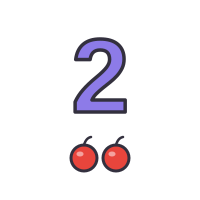 two
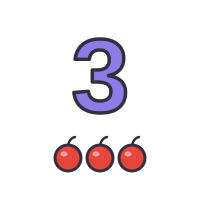 three
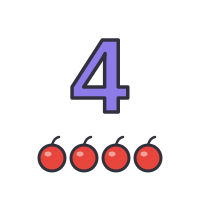 four
| Number | English | Hindi |
|---|---|---|
| 1 | one | ek (एक) |
| 2 | two | do (दो) |
| 3 | three | teen (तीन) |
| 4 | four | chaar (चार) |
| 5 | five | paanch (पाँच) |
| 6 | six | chhah (छह) |
| 7 | seven | saat (सात) |
| 8 | eight | aath (आठ) |
| 9 | nine | nau (नौ) |
| 10 | ten | das (दस) |
| 11 | eleven | gyaarah (ग्यारह) |
| 12 | twelve | baarah (बारह) |
| 13 | thirteen | terah (तेरह) |
| 14 | fourteen | chaudah (चौदह) |
| 15 | fifteen | pandrah (पंद्रह) |
| 16 | sixteen | solah (सोलह) |
| 17 | seventeen | satrah (सत्रह) |
| 18 | eighteen | athaarah (अठारह) |
| 19 | nineteen | unnees (उन्नीस) |
| 20 | twenty | bees (बीस) |
Hindi speakers get a small bonus here: teen is three in Hindi, a handy hook for the teen numbers. Small numbers star in jokes too, and this one works only on paper: “What did zero say to eight? Nice belt!” Our jokes for kids have plenty more like it.
Our number flashcards cut out into cards from one to ten, each with a picture to count and the English word to say.
Number names 21 to 100
Number names from 21 to 100 follow one pattern: say the ten, then the one, with a hyphen between them when you write them, as in twenty-one, thirty-five and ninety-nine. The tens are twenty, thirty, forty, fifty, sixty, seventy, eighty and ninety, and after ninety-nine comes one hundred:
- 21 to 29: twenty-one, twenty-two, twenty-three, twenty-four, twenty-five, twenty-six, twenty-seven, twenty-eight, twenty-nine
- 31 to 39: thirty-one, thirty-two, thirty-three, thirty-four, thirty-five, thirty-six, thirty-seven, thirty-eight, thirty-nine
- 41 to 49: forty-one, forty-two, forty-three, forty-four, forty-five, forty-six, forty-seven, forty-eight, forty-nine
- 51 to 59: fifty-one, fifty-two, fifty-three, fifty-four, fifty-five, fifty-six, fifty-seven, fifty-eight, fifty-nine
- 61 to 69: sixty-one, sixty-two, sixty-three, sixty-four, sixty-five, sixty-six, sixty-seven, sixty-eight, sixty-nine
- 71 to 79: seventy-one, seventy-two, seventy-three, seventy-four, seventy-five, seventy-six, seventy-seven, seventy-eight, seventy-nine
- 81 to 89: eighty-one, eighty-two, eighty-three, eighty-four, eighty-five, eighty-six, eighty-seven, eighty-eight, eighty-nine
- 91 to 99: ninety-one, ninety-two, ninety-three, ninety-four, ninety-five, ninety-six, ninety-seven, ninety-eight, ninety-nine
- 100: one hundred, or a hundred
A child who knows the eight tens and the numbers one to nine has every name from 21 to 99, so the work after twenty is mostly the tens.
Teen and ty numbers
Teen and ty numbers sound alike, and the difference is in the stress: thirteen is said thir-TEEN, with the loud part at the end, and thirty is said THIR-ty, with the loud part at the start.
In a row, as in thirteen, fourteen, fifteen, the stress often moves to the front, so the ending is the surer clue. Teen numbers end in a long een sound with an n, ty numbers end in a short ee, and in American English the t in thirty often sounds like a soft d. Grown-ups mix up fifteen and fifty on the phone all the time, so a child who asks “Fifteen or fifty?” is asking a sensible question, and the usual fix is to say the digits: “one five” or “five oh.”
How to spell number names
To spell number names, start from one to nine and watch for a few small changes in the teens and the tens:
- Four, fourteen, forty: fourteen keeps the u, and forty drops it.
- Three, thirteen, thirty: the start changes to thir.
- Five, fifteen, fifty: the v becomes an f.
- Eight, eighteen, eighty: only one t, where eight meets teen or ty.
- Two, twelve, twenty: all three start with tw, a sign that they belong to one family.
- Nine, nineteen, ninety: the e stays in all three.
In a longer number, the hyphen still sits only between the ten and the one: one hundred and twenty-five.
Hundred, thousand and million
Hundred, thousand and million are the English words for bigger numbers: a hundred is 100, a thousand is 1,000, a million is 1,000,000 and a billion is a thousand million.
In British and Indian English, and comes after hundred: one hundred and five, three hundred and sixty-five. American English often leaves it out, one hundred five, and both are correct where they are used.
After a number, these words stay singular: two hundred, five thousand, ten million. The plural comes only when no number stands before the word: “Hundreds of birds sat on the wire.” “Thousands of people came to the fair.” A hundred and one hundred mean the same, and a is the everyday choice, while one hundred sounds more exact and careful.
Lakh and crore in English
Lakh and crore are Indian English words for big numbers: one lakh is a hundred thousand, and one crore is ten million, or a hundred lakh.
Indian writing also places the commas differently. The first comma comes after three digits from the right, and then a comma after every two, so one lakh is written 1,00,000 in India and 100,000 in most other countries:
| Indian digits | Indian English | International digits | International English |
|---|---|---|---|
| 1,000 | one thousand | 1,000 | one thousand |
| 10,000 | ten thousand | 10,000 | ten thousand |
| 1,00,000 | one lakh | 100,000 | one hundred thousand |
| 10,00,000 | ten lakh | 1,000,000 | one million |
| 1,00,00,000 | one crore | 10,000,000 | ten million |
| 1,00,00,00,000 | one hundred crore | 1,000,000,000 | one billion |
Both words came into English from Hindi, which took them from Sanskrit: lakh from laksha and crore from koti. Indian newspapers and banks use them every day, and India itself has more than 140 crore people, or about 1.4 billion.
How to say zero, phone numbers and years
To say zero in English, use zero, which every English speaker knows, nought, which British English also uses for the digit 0, or oh, the short name used inside phone numbers, room numbers and years, as in “room two oh four” or “nineteen oh five.”
Phone numbers are said one digit at a time, in small groups with a short pause between them. British and Indian English say double and triple for repeated digits, so 77 becomes “double seven” and 000 becomes “triple oh,” while Americans usually say each digit: “seven seven.”
Years are usually said in two pairs: 1999 is nineteen ninety-nine, and 2026 is twenty twenty-six. The years from 2000 to 2009 are said as whole numbers, two thousand and five, or two thousand five in American English. Dates add the names from our guide to the months of the year, and clock times use the same number names, as in seven forty-five, the way our guide to telling time shows.
Where number names come from
Number names in English come from Old English, and the teens and tens still show how they were built: teen comes from ten, so fourteen is four and ten, and ty comes from an old word for a group of ten, so forty is four tens.
Older English counted in twenties as well. A score is twenty, from an old word for a notch cut on a tally stick, and Abraham Lincoln opened a famous speech in 1863 with “Four score and seven years ago,” which means 87 years. A dozen is twelve, a word built on the French douze, and eggs and bananas are still sold by the dozen.
Zero and the digits 0 to 9 came from India. The Indian mathematician Brahmagupta wrote rules for working with zero in 628, and the digits traveled west in Arabic writings and reached Europe through Latin translations, which is why they are called Hindu-Arabic numerals. The English word zero comes, through Italian, from the Arabic sifr, a translation of the Sanskrit shunya (शून्य), empty.
Number names in other languages
Number names in other languages can follow very different rules, and Hindi shows it best: every number from 1 to 100 has a name of its own, so 35 is paintees (पैंतीस) and 47 is saintaalees (सैंतालीस), and a child learns a hundred separate words.
Spanish builds 16 to 19 from ten and a number: dieciséis, sixteen, began as diez y seis, ten and six. French is famous for 70 to 99: 70 is soixante-dix, sixty-ten, 80 is quatre-vingts, four twenties, and 90 is quatre-vingt-dix, four twenties and ten. In Belgium and Switzerland, French speakers say septante for 70 and nonante for 90.
A child who already counts at home in Hindi, Tamil or Bengali has a head start, because the idea of a number is the same in every language and only the names change. Our post on the mother tongue has more on keeping both.
Games with number names
Games with number names need small paper cards, a marker, a long strip of paper, a calculator and a few rupee notes, and one game needs only a car ride: digit swap, zero train, plate pairs, calculator talk and rupee notes.
1. Digit swap
Write the digits 1 to 9 on small paper cards, one digit per card. Your child picks two cards, lays them side by side and says the number: “Four and two, forty-two!” Then swap the two cards and say the new number: “Twenty-four!” The same two digits make two different numbers, and the card on the left always gives the ten. Make each card about the size of your palm, and gather them up when the game ends.
2. Zero train
Write a big 1 at the left end of a long strip of paper: that is the engine. Each time your child adds a zero after it, a new coach joins the train, and you say its name together: “Ten. A hundred. A thousand. Ten thousand. One lakh!” Keep going to ten lakh and one crore. Write the commas in as the train grows, so the lakh and the crore stand out: 1,00,000 and 1,00,00,000.
3. Plate pairs
On a car ride, read the four-digit number on the plate of the car in front of you in two pairs, the way English says years: 4572 becomes “forty-five seventy-two.” Your child reads the next plate with you, and before long reads one alone. A plate like 1330 is a lucky catch: thirteen thirty, a teen and a ty side by side, so your child has to listen for the ending. Play from the back seat, and leave the driver to watch the road.
4. Calculator talk
Give your child a calculator, or a phone with the calculator open, and let them press one digit at a time while you read the number on the screen as it grows: “Seven. Seventy-two. Seven hundred and twenty-five!” Press the clear key and start again. Use a calculator with a screwed-shut battery cover, since button batteries are dangerous if swallowed. Before long, your child reads the short ones alone, and the long names become the fun part: “Seven lakh, twenty-five thousand!”
5. Rupee notes
Lay out a few rupee notes: ten, twenty, fifty, a hundred, two hundred and five hundred. Name one, “Find the fifty!”, and your child finds it and says its full name back: “Fifty rupees!” Every Indian note also carries its name in English words, in the line “I promise to pay the bearer the sum of fifty rupees,” so read it out together. Keep coins out of this game, since they fit in a small mouth, and put the notes away when it ends.
Try it today
- In a lift, let your child press the button for your floor and say the number on it, and keep small hands away from the closing doors.
- Each time you come home, say the number on your door or gate together, so your child knows the number of your home.
- Say your phone number together in English once a day, in the same small groups every time: “Nine eight, double seven…”
Questions parents ask
Why isn’t eleven called oneteen?
Eleven and twelve come from an older pattern. In Old English they were endleofan and twelf, which meant one left and two left: one and two left over after counting ten. The teen pattern starts at thirteen.
What is the biggest number?
There is no biggest number: add one to any number, and you get a bigger one. Some very big numbers have names, though, like a googol, a 1 followed by a hundred zeros, a name made up by Milton Sirotta, the young nephew of the American mathematician Edward Kasner.
What is the difference between a number and a numeral?
A number is the amount itself, a numeral is the sign written for it, such as 7, and the number name is the word, seven. Children often know a number name long before they can pick out its numeral, so saying the names comes first. Our guide to counting covers the step from the names to counting real things.
Is it five lakh or five lakhs?
Five lakh is the standard form, the same way English says five hundred and five thousand, and Indian newspapers write it that way. Five lakhs is common in everyday speech, and people understand both.
Saying every number from 1 to 100 takes a couple of minutes, and a Tatako lesson takes only a little longer: about five minutes a day, with every new word said three times and a pause for your child to answer.