

Masculine and feminine words in English are pairs that name a male and a female: boy and girl, king and queen, lion and lioness. Masculine words are for men, boys and male animals, and feminine words are for women, girls and female animals. English has far fewer of them than Hindi, Spanish or French, because most English nouns, like nurse, neighbor and cook, fit everyone, and verbs and adjectives never change with gender. In a large comparison of languages from all over the world, more than half have no grammatical gender at all.
That keeps the list short enough to learn in pairs, and family words, royal words and farm animals cover most of it. Our post on family words starts with the names a child needs first for the people at home.
In this guide
- Masculine and feminine words list
- Masculine and feminine animals
- Feminine words with the ess ending
- Words with man and woman
- Titles for men and women
- Common and neuter gender
- Masculine and feminine in other languages
- Where masculine and feminine words come from
- Games with masculine and feminine words
- Questions parents ask
Masculine and feminine words list
The masculine and feminine words list below has the pairs a child hears most, with the Hindi pair beside each:
 boy
 girl
 brother
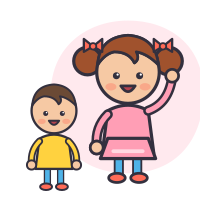 sister
| Masculine | Feminine | Hindi |
|---|---|---|
| boy | girl | ladka, ladki (लड़का, लड़की) |
| man | woman | aadmi, aurat (आदमी, औरत) |
| father | mother | pita, mata (पिता, माता) |
| son | daughter | beta, beti (बेटा, बेटी) |
| brother | sister | bhai, behen (भाई, बहन) |
| grandfather | grandmother | dada, dadi (दादा, दादी) |
| uncle | aunt | chacha, chachi (चाचा, चाची) |
| nephew | niece | bhatija, bhatiji (भतीजा, भतीजी) |
| husband | wife | pati, patni (पति, पत्नी) |
| bridegroom | bride | dulha, dulhan (दूल्हा, दुल्हन) |
| king | queen | raja, rani (राजा, रानी) |
| prince | princess | rajkumar, rajkumari (राजकुमार, राजकुमारी) |
Most English pairs are two different words, so a child who knows father still has to learn mother as a new word, and son gives no clue about daughter. A few pairs share a part, like grandfather and grandmother, and those come quickly once the first half is known. Our family flashcards put mommy and daddy, grandma and grandpa, and brother and sister on cards to color in and cut apart.
Masculine and feminine animals
Masculine and feminine animals often have names of their own: a male horse is a stallion and a female horse is a mare, while a male lion is simply a lion and the female is a lioness.
| Animal | Male | Female |
|---|---|---|
| lion | lion | lioness |
| tiger | tiger | tigress |
| horse | stallion | mare |
| cattle | bull | cow |
| cat | tom | queen |
| ferret | hob | jill |
| kangaroo | boomer | flyer |
| chicken | rooster | hen |
| peafowl | peacock | peahen |
| fox | dog fox | vixen |
| bee | drone | queen |
Elephants and whales borrow the cattle words, so a male elephant is a bull and a female is a cow. In a beehive, the queen and the worker bees are all female, and the drones are the males. Duck and goose work two ways: they name the whole animal and also the female, while the males are a drake and a gander. More bird pairs, such as the swan’s cob and pen, are in our guide to bird names, and the farm pairs with their young, from ram and ewe to billy goat and nanny goat, are in our guide to animals and their young ones.
Feminine words with the ess ending
Feminine words with the ess ending are built by adding ess to the masculine word, and some words change their spelling on the way:
- Just add ess: lion and lioness, host and hostess, heir and heiress, steward and stewardess.
- Drop or double a letter: prince and princess, tiger and tigress, actor and actress, waiter and waitress, god and goddess.
- Bigger changes: emperor and empress, duke and duchess, master and mistress.
- Other endings: hero and heroine, sultan and sultana.
Two pairs work the other way around, with the masculine word built from the feminine one: a widower is a man whose wife has died, a word made from widow, and bridegroom grew out of bride. Today many women call themselves actors and hosts, and airlines now say flight attendant for a steward or a stewardess, so the ess words are heard most for animals, for royal families and in stories such as The Princess and the Pea, one of our fairy tales for kids.
Words with man and woman
Words with man and woman make pairs by swapping the last part: policeman and policewoman, salesman and saleswoman, chairman and chairwoman. Other pairs follow the same plan with their own parts: stepfather and stepmother, godfather and godmother, landlord and landlady.
Many jobs now have one word for everyone. A firefighter can be a man or a woman, and older English said fireman. Police officer, salesperson and chairperson are the usual words in news reports and job ads today. Children meet both kinds, so both are worth knowing: a fireman in an old story and a firefighter at the fire station.
Titles for men and women
Titles for men and women go before a name: Mr is for any man, Mrs for a married woman, Miss for an unmarried woman or a girl, and Ms for any woman, married or not. Mr is short for mister, and Mrs and Miss both come from mistress, the old feminine of master.
Without a name, English uses sir and madam, often shortened to ma’am. Children in India call a teacher sir or ma’am, and every older family friend or neighbor becomes uncle or aunty, a habit of Indian English that surprises many visitors from America and Britain, where uncle and aunt are mostly kept for relatives.
Common and neuter gender
Common and neuter gender cover the words that are neither masculine nor feminine. A noun of common gender names a person or an animal of either sex: doctor, friend, parent, child, cousin, singer, pilot. A noun of neuter gender names a thing with no sex at all: table, pencil, tree, river, and English calls it it.
Most English words for people are common gender, and the rest of the sentence shows who is meant: “My cousin is coming. She lives in Pune.” Indian English adds a word to show it at once, cousin brother and cousin sister, which English speakers in other countries rarely use. Animals are usually it until they have a name: a stray dog is it, and the family dog is he or she.
Masculine and feminine in other languages
Masculine and feminine in many other languages reach every noun, even the words for things. In Hindi, paani (पानी), water, is masculine, and chai (चाय), tea, is feminine, and so are kursi (कुर्सी), chair, and mez (मेज़), table. Verbs and adjectives change to match, so a boy says “main khata hoon” and a girl says “main khati hoon” for I eat, and a good boy is accha ladka while a good girl is acchi ladki.
Hindi also has a separate word for each uncle and aunt: chacha is the father’s younger brother, tau the father’s older brother and mama the mother’s brother, and their wives are chachi, tai and mami. English has only uncle and aunt for all of them.
Spanish and French give every noun a gender too, with el or la in Spanish and le or la in French: el niño and la niña, a boy and a girl, and le garçon and la fille in French. Languages also give the same thing different genders: the sun is masculine in Spanish (el sol), French (le soleil) and Hindi (suraj), and feminine in German (die Sonne), while the moon is feminine in Spanish (la luna) and French (la lune) and masculine in German (der Mond) and Hindi (chaand). Our post on the mother tongue has more on growing up with two languages.
Where masculine and feminine words come from
Most masculine and feminine words in English come from Old English, the language spoken in England about a thousand years ago. Lord comes from the Old English hlaford, the keeper of the loaf, and lady from hlaefdige, the one who kneads the dough, so the two words once named the people in charge of the bread of a house. King comes from cyning, and queen from cwen, an old word for a woman or a wife.
Man once meant any person, man or woman, and woman grew out of wifman, a female person. Girl went the other way: in the 1300s it meant a young child of either sex, and only later came to mean a young female. The ess ending came into English from French, which took it from Latin and Greek, and Ms, the newest title here, came into everyday use in the 1970s.
Games with masculine and feminine words
Games with masculine and feminine words need paper cards, a marker, scissors and crayons, and one game needs nothing at all: add the ess, mane and antlers, last sound swap, pair dominoes and puzzle pairs.
1. Add the ess
Write lion, host, tiger, prince and god on paper cards, one word per card, and write ess on a small card of its own. Your child slides the ess card next to a word, and you read the new word together: “Lion… lioness!” For tiger and prince, your child covers the last e with a thumb before adding ess, and for god, you add a second d with the marker: “Goddess!” The grown-up cuts the cards and keeps the scissors.
2. Mane and antlers
Draw a plain lioness, a doe, a hen and a peahen with crayons. Your child turns each one into the male: a big mane for the lioness, antlers for the doe, a tall red comb for the hen and a long fan of tail feathers for the peahen. Name both as the drawing changes: “A lioness… and now a lion!” Each drawing shows the real way to tell the two apart, because only male lions grow a mane, and in most kinds of deer only the males grow antlers. Stay close while the crayons are out, and put them away afterward so none end up in a mouth.
3. Last sound swap
Say a Hindi word for a male, and your child turns it into the female by changing the last sound: ladka, ladki; beta, beti; nana, nani; raja, rani. Then say the English pair together: “Boy, girl. Son, daughter. King, queen.” With Spanish, the same game works with niño and niña or abuelo and abuela.
4. Pair dominoes
The grown-up cuts six paper cards and keeps the scissors, then draws a line across the middle of each. On each card, write a feminine word on the left half and a masculine word from another pair on the right: queen and lion, lioness and prince, princess and bull, cow and boy, girl and rooster, hen and king. Your child lays the cards end to end so that each pair meets at the join: “Lion, lioness. Prince, princess!” When all six are down, the row closes into a ring, because the king on the last card meets the queen on the first. For a child who doesn’t read yet, draw a small picture beside each word.
5. Puzzle pairs
Write a pair on one card, such as king on the left half and queen on the right, and cut the card in two along a zigzag line. Make five or six cards like this with different pairs, mix the halves on the floor, and let your child find the halves that fit: “Uncle and aunt!” Each half fits only its own partner, so the shapes check every answer. The grown-up does the cutting, and your child does the matching.
Try it today
- At a zoo or on a farm, look for a male and a female of the same animal and name both: “A rooster and a hen.”
- When a wedding comes up, in the family or on a screen, name the bride and the bridegroom together.
- When you meet a neighbor’s dog or cat, ask whether it is a he or a she, and use that word from then on: “She is so soft!”
Questions parents ask
What is the feminine of hero?
Heroine is the feminine of hero, and in Indian English it is also the word for the lead actress of a film, as hero is for the lead actor. Hero now works for anyone too: “My grandmother is my hero.”
Is teacher masculine or feminine?
Teacher is common gender in English and fits a man or a woman. Hindi has two words, adhyapak (अध्यापक) for a man and adhyapika (अध्यापिका) for a woman, and so do Spanish, maestro and maestra, and French, instituteur and institutrice.
Why is a ship called she?
Sailors have called ships she for hundreds of years, the way some people talk about a car they love. The Royal Navy still does, while Lloyd’s List, a shipping newspaper in London, switched to it in 2002. Both are correct, and most news reports today use it.
Do all animals have a masculine and feminine name?
Only some do. Most of the special names belong to farm animals and to animals people hunted, such as stallion and mare or stag and hind, because farmers and hunters needed to tell them apart. For most wild animals, English says a male frog or a female frog.
King and queen, lion and lioness: English keeps many of its words in pairs, and a Tatako lesson adds new words in about five minutes a day, saying each one three times with a pause for your child to answer.